
How to Build Interactive Study Guides: 7 Learning Techniques Using Spin Wheels
Ditch passive re-reading. Learn how to combine active recall and spaced repetition with interactive spin wheels. Discover 7 study wheel techniques to boost memory retention and academic performance.

Introduction
If you have ever spent hours highlighting a textbook, only to realize the next day that you can barely remember a single concept, you are not alone. Traditional studying methods—like re-reading notes, highlighting text, and reviewing summaries—are incredibly popular, but cognitive science has proven they are among the least effective ways to learn. These methods create an "illusion of competence," where familiarity with the text is mistaken for actual mastery of the material.
To move information from short-term memory to long-term memory, the brain must be challenged. It needs to actively work to retrieve information, a process known as active recall.
One of the most effective ways to introduce active recall and eliminate predictable study patterns is by using interactive digital study wheels. By transforming a static list of questions or vocabulary terms into a colorful, random spinner, you can gamify your study sessions, lower test anxiety, and significantly increase your memory retention.
In this comprehensive guide, we explore the science behind active retrieval and share 7 practical learning techniques using a study wheel helper to supercharge your academic prep.
The Cognitive Science of Learning: Active Recall & Spaced Repetition
Before exploring the study techniques, it is essential to understand the two pillars of memory science:
1. Active Recall
Active recall is the practice of testing yourself to retrieve information from your brain, rather than forcing information into it. When you look at a flashcard and try to remember the definition on the back, your brain builds stronger neural pathways to that information. Passive reading is like looking at a map; active recall is like driving the route yourself.
2. Spaced Repetition
Spaced repetition is the practice of reviewing information at increasing intervals over time (e.g., 1 day later, 3 days later, 7 days later). This counters the "Forgetting Curve"—a mathematical formula describing how memory fades over time if no attempt is made to retain it.
How a Randomizer Wheel Bridges the Gap
When we study a static list of questions, our brains naturally look for patterns and sequence shortcuts. We memorize that Question 3 comes after Question 2, which inflates our perceived accuracy.
A digital randomizer wheel removes all predictable order. It presents questions in a chaotic, unpredictable sequence, forcing your brain to retrieve the information in isolation. This mimicry of real exam conditions builds resilient, flexible recall.
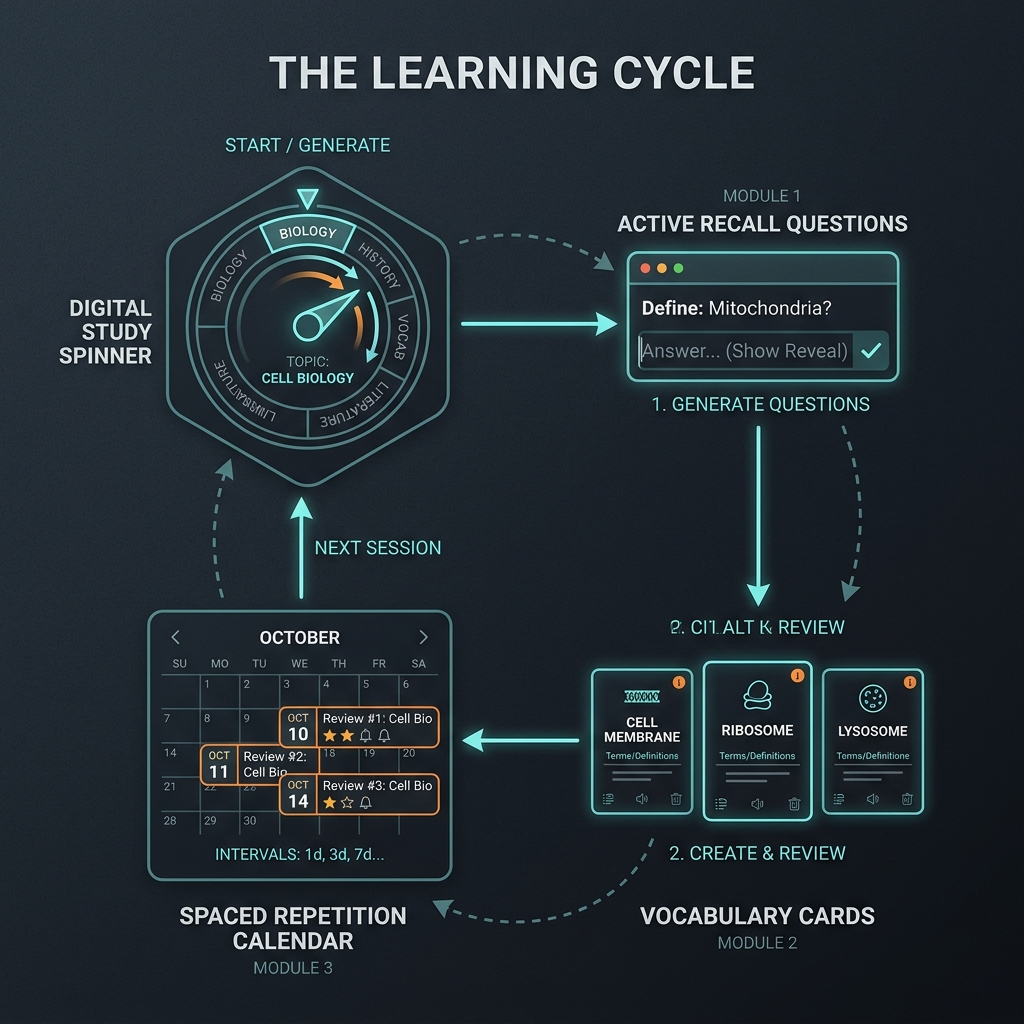
7 Study Wheel Techniques to Supercharge Your Retention
1. The Active Recall Question Spinner
This is the direct replacement for standard, linear review sheets. It forces you to answer questions out of order, mimicking the layout of a real exam.
- How to Set It Up: Input the key questions or prompts from your syllabus or study guide into the slices of the wheel.
- How to Play: Spin the wheel. Whichever question the pointer lands on, you must answer aloud or write down the answer from memory before checking your notes.
- Best For: History, biology, or any concept-heavy subject where you need to explain processes or list facts.
2. Vocabulary & Flashcard Roulette
Memorizing vocabulary lists in order is a common trap. Flashcard roulette breaks this habit and tests deeper understanding.
* How to Set It Up: Put your vocabulary words or foreign language terms on the wheel. * How to Play: Spin the wheel. Once a word is selected, you must perform three steps: 1. Provide the definition in your own words. 2. Use the word correctly in a complete sentence. 3. Identify one synonym or antonym. * Best For: Foreign language learning, SAT/GRE prep, medical terminology, and legal definitions.
3. Spaced Repetition Interval Decider
If you have a large stack of flashcards or multiple study topics, it can be difficult to decide what to study next and how to space out your reviews.
- How to Set It Up: Populate the wheel with review intervals (e.g., "Review Tomorrow," "Review in 3 Days," "Review in 7 Days," "Mastered - Review before Exam").
- How to Play: After self-testing on a specific topic or flashcard stack, spin the interval wheel to decide its next review placement. This keeps your study schedule dynamic and prioritizes weak areas.
- Best For: Long-term exam preparation, board exams, and cumulative finals.
4. Group Study Discussion Prompts
Study groups are highly effective, but they can easily devolve into unstructured chatting. Using a prompt wheel keeps the group focused and ensures everyone participates.
- How to Set It Up: Slices contain cognitive tasks, such as: "Explain this concept to a 5-year-old," "Draw a diagram on the whiteboard," "Argue the counterpoint," "Give a real-world example," or "Identify a common misconception about this topic."
- How to Play: One group member spins the random name selector to choose the presenter, then spins the prompt wheel. The chosen player has 60 seconds to explain the active topic using the style selected by the wheel.
- Best For: Collaborative study groups, AP classes, and exam prep clubs.
5. The Pomodoro Task Allocator
The Pomodoro Technique involves studying in focused, 25-minute blocks followed by a 5-minute break. A task allocator wheel helps you decide how to spend each block without experiencing decision fatigue.
- How to Set It Up: Slices contain the tasks you need to complete today (e.g., "Write Intro Paragraph," "Solve 5 Math Problems," "Review Biology Notes," "Create Flashcards").
- How to Play: Spin the wheel at the beginning of each 25-minute session. Commit to focusing solely on the selected task until the timer rings.
- Best For: Combating procrastination, managing large workloads, and improving focus.
6. Mistake Review Log Audit
The fastest way to improve your grade is to systematically review and correct your past mistakes.
- How to Set It Up: Review your past quizzes, homework assignments, or mock exams. Identify every question you got wrong and input the corresponding concept names onto the wheel.
- How to Play: Spin the wheel during your review session. Whichever concept lands, find the original mistake, explain why it was incorrect, and solve a new, similar problem correctly.
- Best For: Mathematics, physics, chemistry, and accounting, where problem-solving mechanics are critical.
7. Self-Testing Mode Selector
Testing yourself in different formats prepares your brain to handle whatever question styles appear on the actual exam.
- How to Set It Up: Slices contain exam formats: "Multiple Choice (create 3 options)," "Short Answer," "True or False (and explain why)," "Fill in the Blank," or "Explain to a Peer."
- How to Play: Spin a topic wheel to select a concept, then spin the mode wheel. You must test yourself on that concept using the selected format.
- Best For: Comprehensive exam preparation and building test-taking flexibility.
Best Practices for Designing a Study Wheel
To make your study wheels highly effective, follow these structural design tips:
| Design Rule | Description | Why it Matters |
|---|---|---|
| Keep Slices Concise | Use short keywords or brief questions rather than long paragraphs. | Keeps the wheel readable and fast-spinning. |
| Use High Contrast Colors | Assign contrasting colors to adjacent slices. | Improves visual focus and readability during spins. |
| Limit Wheel Size | Keep the wheel between 8 and 20 slices. If you have more, split them into multiple sub-wheels. | Prevents overcrowding and keeps slices legible. |
| Update Regularly | Remove concepts once you have fully mastered them, and add new ones as your class progresses. | Prioritizes weak areas and saves study time. |
Summary
Studying does not have to be a boring chore of staring at a page and hoping the information sticks. By converting your study guides into dynamic, interactive spinners, you engage your brain in active recall and spaced repetition in a fun, gamified format. Whether you are prepping for a medical board exam, practicing vocabulary, or keeping your study group on track, try building a custom study helper wheel, spin it, and watch your memory retention soar!