
The Math Behind Randomness: Understanding Probability and Fair Spins in Digital Wheels
How does a digital wheel decide where to stop? Discover the mathematics of pseudo-random number generators (PRNG), seed values, slice probability mapping, and why digital spin wheels are fairer than physical ones.
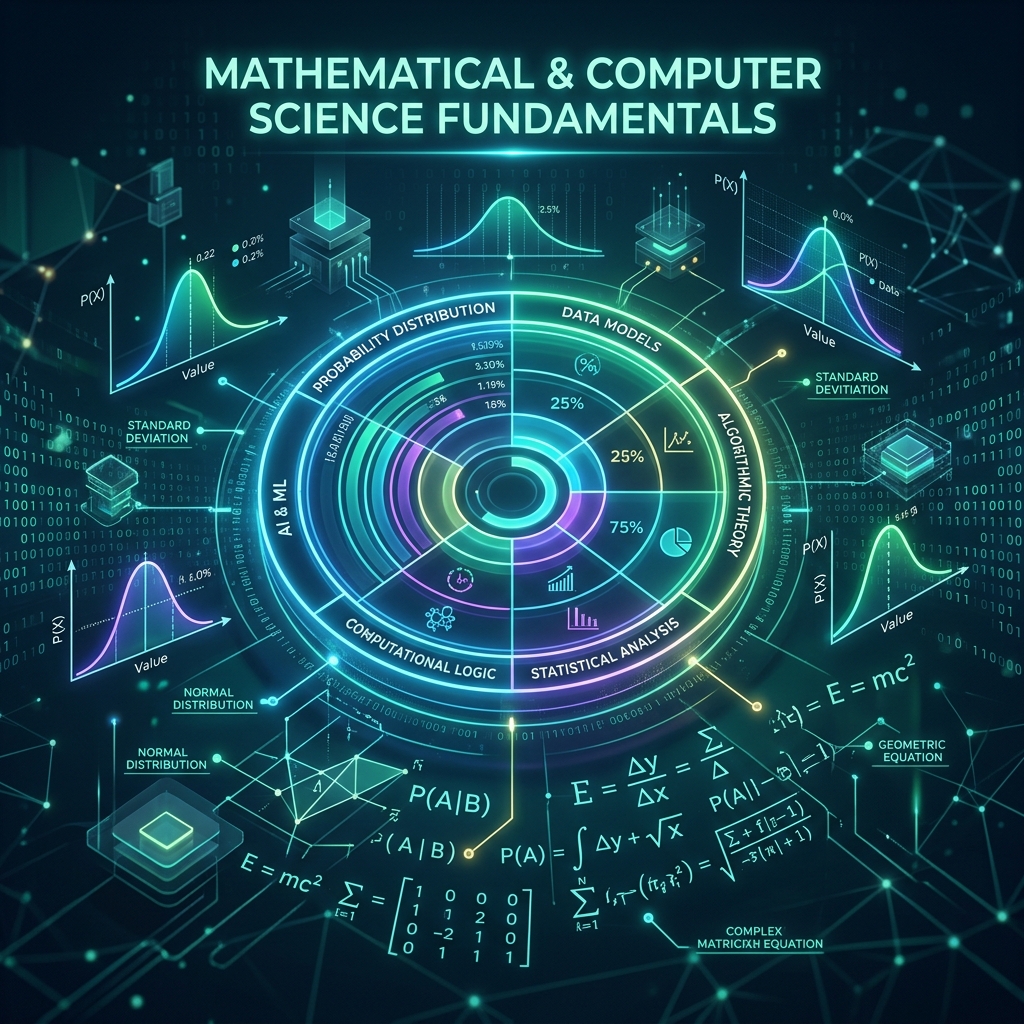
Introduction
There is a universal thrill in watching a spin wheel slow down. As the pointer ticks from segment to segment, the suspense builds: Will it land on the grand prize, the chores you have been avoiding, or a student's name in a classroom?
Whether you are using a spinner to run a promotional giveaway, pick a raffle winner, make a quick dinner decision, or choose who speaks next in a corporate meeting, one critical question lies beneath the animation: Is this wheel truly fair?
When we spin a physical wheel, we trust the laws of physics—friction, gravity, and momentum—to distribute the outcomes fairly. But when we click a button on a computer or mobile screen, physics is replaced by mathematics. There are no ball bearings or air resistance; instead, a series of invisible calculations decides the outcome in a fraction of a millisecond.
In this article, we peel back the screen and examine the mathematics of digital randomness. We explore how computers simulate chance, how algorithms map numbers to wheel slices, and why a well-designed digital spinner is actually much fairer than its physical counterpart.
The Illusion of Randomness: TRNG vs. PRNG
To understand how a digital wheel spins, we must first understand how computers think. At their core, computers are deterministic machines. If you give a computer the exact same inputs and instructions, it will always produce the exact same output. By design, computers are built to be predictable—which makes generating "randomness" a major mathematical challenge.
To solve this, computer scientists categorize random number generation into two distinct types:
1. True Random Number Generators (TRNG)
True randomness is derived from unpredictable physical phenomena outside the computer. Examples include: * Radioactive decay of atoms. * Atmospheric noise (radio static). * Thermal fluctuations in electronic resistors.
Because these physical processes are fundamentally chaotic and unpredictable, they generate true randomness. However, TRNGs require specialized hardware sensors and are slow to calculate, making them impractical for standard web applications like a digital wheel spinner.
2. Pseudo-Random Number Generators (PRNG)
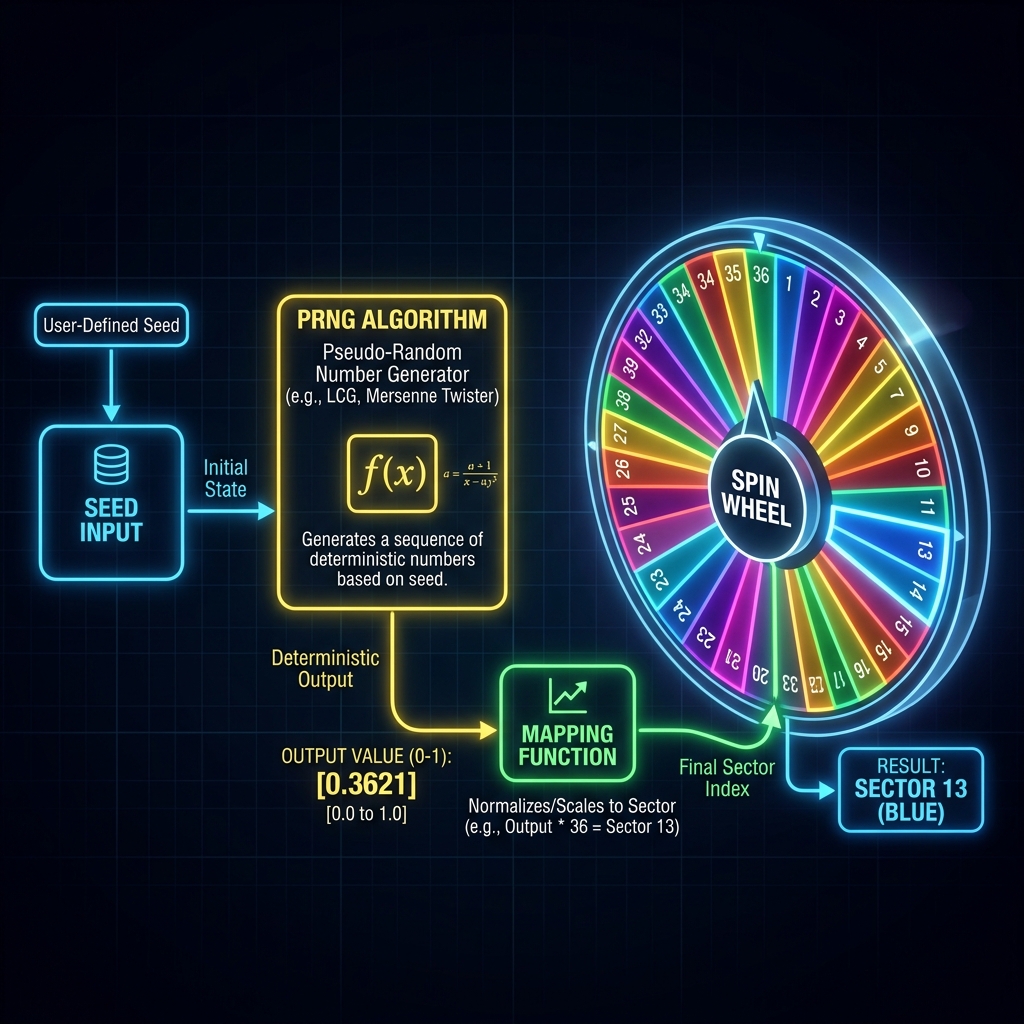
Instead of physical noise, web browsers use Pseudo-Random Number Generators. A PRNG is a mathematical algorithm that starts with an initial number (called a seed) and applies a complex sequence of algebraic operations to generate a long chain of numbers that appear random.
While a PRNG is technically deterministic—meaning that if you know the seed and the algorithm, you can predict every single number in the sequence—the formulas are so complex that the output is indistinguishable from true randomness for all practical purposes.
How Modern Web Browsers Generate Random Numbers
When you click "Spin" on an online wheel, the website executes a line of JavaScript code. In standard JavaScript, this is done using the built-in function Math.random().
But how does Math.random() actually work under the hood?
The browser engine (such as Google Chrome's V8 engine, Safari's JavaScriptCore, or Firefox's SpiderMonkey) uses a specific PRNG algorithm to resolve this function. In modern browsers, this is typically the xorshift128+ or the xoshiro256** algorithm.
These algorithms are prized in web development for being: * Extremely Fast: They perform calculations using bitwise operations (shifting binary bits left or right), which execute in a few nanoseconds. * Statistically Uniform: They pass strict tests for randomness, ensuring there are no recurring patterns or clustering of numbers. * Long-Period: The sequence of numbers they generate before repeating is massive—typically 2 raised to the power of 128 (a number with 39 digits), meaning the wheel would have to be spun trillions of times before repeating a pattern.
The Role of Seed Values
A PRNG cannot start without a seed. If a PRNG used the exact same seed every time you loaded the webpage, every user would experience the exact same sequence of spins.
To prevent this, modern web applications automatically seed their algorithms using dynamic, highly specific parameters. The most common source is the system clock, measured in milliseconds since January 1, 1970 (Unix Epoch Time), combined with user interaction metadata (such as the exact coordinates of the mouse click or the duration the button was held). This ensures that no two sessions ever share the same starting point.
How Random Numbers Are Mapped to Wheel Slices
Once the PRNG generates a random number, the website must map that number to a specific segment of the wheel. Let us look at the mathematics of this mapping process.
A PRNG like Math.random() always outputs a decimal value between 0 (inclusive) and 1 (exclusive), written mathematically as [0, 1).
To convert this decimal into a slice selection, the software performs three main steps:
Step 1: Calculating the Total Weight
By default, an equal-slice wheel treats all options as having the same probability. However, advanced custom spinners allow users to apply custom "weights" (or probabilities) to different slices.
To map these, the algorithm first calculates the sum of all weights:
Total Weight = Weight(Slice 1) + Weight(Slice 2) + ... + Weight(Slice N)For a simple 4-slice wheel where each slice has a weight of 1, the Total Weight is 4.
Step 2: Selecting the Winning Slice
The algorithm multiplies the random decimal r (generated by the PRNG) by the Total Weight to get a target value T:
T = r * Total WeightFor example, if r = 0.65 and the Total Weight is 4, then T = 2.60.
The algorithm then iterates through the slices, accumulating their weights until it reaches or exceeds the target value T. Let us see how this works in a table:
| Slice | Individual Weight | Cumulative Weight Range | Does T (2.60) fall in range? | Result |
|---|---|---|---|---|
| Slice 1 (Red) | 1 | [0.00, 1.00) | No | Continue |
| Slice 2 (Blue) | 1 | [1.00, 2.00) | No | Continue |
| Slice 3 (Green) | 1 | [2.00, 3.00) | Yes | Winner! |
| Slice 4 (Yellow) | 1 | [3.00, 4.00) | No | - |
In this case, the wheel selects Slice 3 (Green) as the winner. This method ensures that slices with larger weights occupy a larger share of the cumulative range, making their selection proportionally more likely.
Step 3: Aligning the Physics Animation
To make the user experience premium and satisfying, the physical spinning animation must align perfectly with the mathematical outcome. If the algorithm selects Slice 3, the wheel must rotate to stop precisely within the boundaries of Slice 3.
The software calculates this by: 1. Determining the angle range (in degrees) that Slice 3 occupies on the 360-degree circle. 2. Generating another small random offset to decide where inside that slice the pointer will rest (to avoid landing in the exact center of the slice every time, which would look unnatural). 3. Calculating the total rotation (usually 5 to 10 full 360-degree rotations plus the target angle) to create the illusion of a realistic spin that slowly decelerates due to friction.
Why Digital Wheels Are Fairer Than Physical Ones
It is common to assume that physical objects are naturally "fairer" than computer code. However, in the world of probability, physical spinner wheels are notoriously flawed. Here is why digital wheels offer a superior standard of fairness:
- Zero Manufacturing Bias: A physical wheel is subject to microscopic defects. If one side of the wood or plastic is slightly heavier than the other, gravity will cause the wheel to settle on the heavier side more often, introducing a heavy bias. Digital wheels are made of pure math, completely immune to weight distribution errors.
- No Friction Anomalies: Physical bearings wear down over time. Dust, rust, or uneven lubrication can create "sticky" points on the axle, causing the wheel to slow down prematurely in specific zones. Digital spin animations use smooth mathematical ease-out curves that never degrade.
- Protected Against Human Manipulation: A skilled host can spin a physical wheel with a specific initial force and starting position to skew the outcome toward a desired segment. Digital wheels shield the spin velocity behind a randomized click event, preventing any manual influence on the result.
- Strict Audit Trails: Unlike physical draws where once a wheel stops the physical state is lost, digital platforms can record the outputs of thousands of spins to prove statistical fairness.
How to Verify if a Digital Wheel is Fair
If you are running a high-stakes giveaway, you might want to verify the fairness of your spinner. Fortunately, you do not need a degree in data science to audit your tool. You can perform a simple frequency test to check for uniform distribution:
- The Setup: Create a wheel with 10 identical, equally-weighted segments.
- The Execution: Spin the wheel 1,000 times (many digital tools support automated test spinning or API audits).
- The Audit: Count the number of times each segment is selected.
In a perfectly uniform distribution, each segment has a 10% chance of winning, meaning each segment should be selected roughly 100 times. Because of statistical variance, the numbers will not be exactly 100, but they should cluster closely around it (e.g., between 90 and 110). If one segment wins 250 times while another wins only 30 times, the wheel's randomness is flawed.
Professional web platforms run these frequency audits across millions of simulated spins before deploying their tools, guaranteeing that every user gets an honest, unbiased outcome.
Summary
The next time you click the spin button on a random name selector or lucky draw wheel, you can appreciate the intricate math working behind the scenes. From the PRNG algorithms extracting entropy from your system clock, to the cumulative weight calculations that map the random decimal to a colorful slice, digital wheels rely on robust, predictable mathematics to create the perfect illusion of chance.
By eliminating physical bias and mechanical wear-and-tear, digital wheels like the ones powered by YaySpinner offer a level of fairness and transparency that traditional raffles simply cannot match. Spin with confidence, knowing that math is keeping the game honest!