The Psychology of Decision Fatigue: How Random Spin Wheels Can Help You Make Faster, Better Decisions
Learn about the cognitive science of decision fatigue, how decision paralysis exhausts our willpower, and how a random choices spinner can simplify daily life.
Introduction: The Modern Choice Epidemic
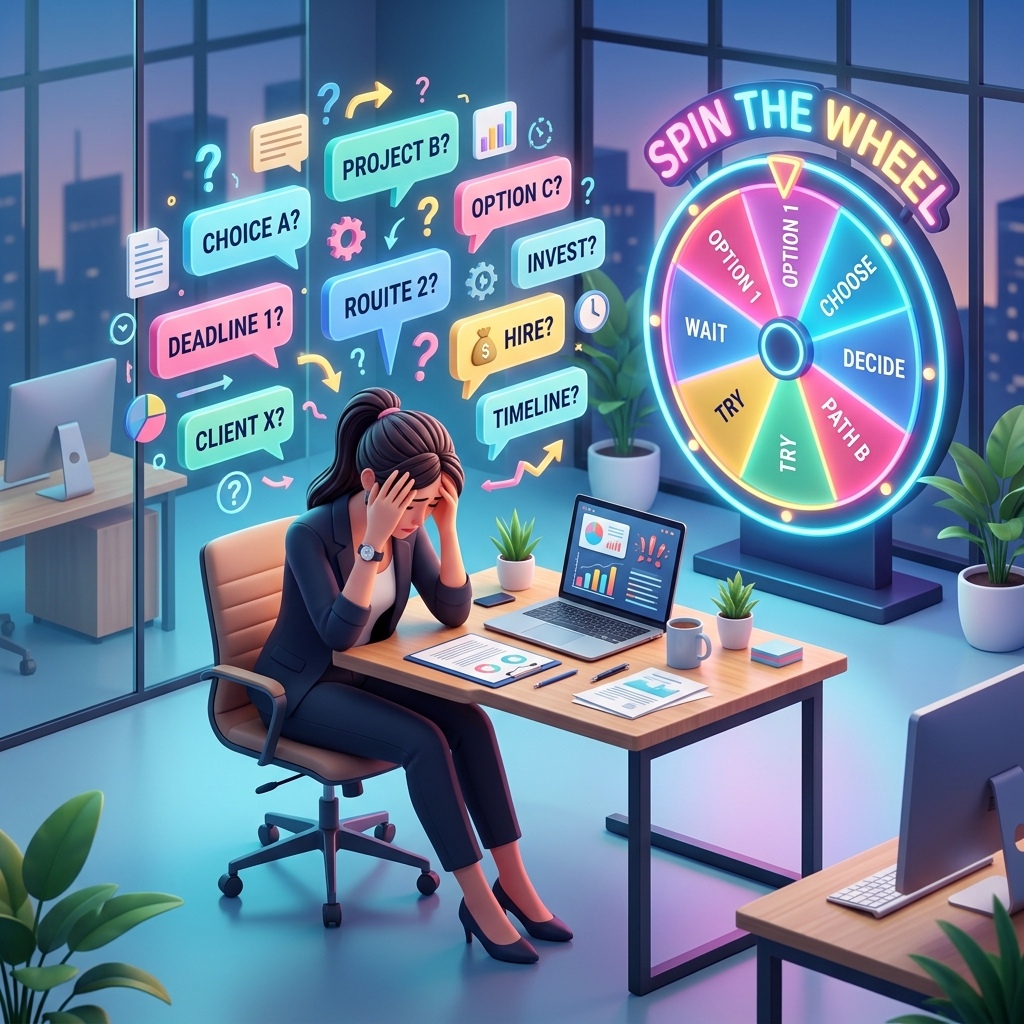
Every day, the average adult makes roughly 35,000 decisions. From the moment we wake up, we are faced with a continuous stream of choices: Should I hit snooze? What should I wear today? Should I check my email or check my phone first? What should I eat for breakfast? Which route should I take to work?
While modern society celebrates this abundance of choices as the ultimate expression of freedom, cognitive science suggests it comes with a significant cost. The human brain, despite its incredible processing power, operates on a finite energy supply. Every choice we make, no matter how small, depletes a portion of our cognitive reserves.
By the time we face critical professional or personal challenges in the afternoon, our brains are exhausted. This state of mental depletion is known as decision fatigue. It leads to procrastination, poor choices, and stress.
Fortunately, you don't have to suffer from choice paralysis. By understanding the psychology of decision-making and learning how to outsource trivial choices to a simple choices spinner, you can conserve your willpower for the decisions that truly matter. In this article, we explore the science behind decision fatigue and show how a random decision generator can simplify your daily routine.
What is Decision Fatigue? (The Science of Brain Power)
To understand why making decisions is so tiring, we must look at how the brain manages willpower. The concept of decision fatigue was popularized by social psychologist Roy F. Baumeister, who developed the theory of ego depletion.
Baumeister's research suggests that willpower is not a skill or a state of mind—it behaves like a muscle. When you use a muscle repeatedly, it experiences fatigue and loses strength. Similarly, your brain relies on a limited pool of mental energy to exercise self-control, resist distractions, and make choices.
The Role of the Prefrontal Cortex The prefrontal cortex is the executive center of the brain, responsible for logical reasoning, goal setting, and impulse control. When you make a decision, this area of the brain consumes glucose at an accelerated rate. As your glucose levels drop, the prefrontal cortex becomes less efficient. * **The Consequences:** When mental energy is low, the brain starts looking for shortcuts. This typically manifests in two ways: * **Impulsivity:** You make reckless decisions without considering the long-term consequences because your brain lacks the energy to calculate risks. * **Avoidance (Paralysis):** You postpone decisions entirely, opting for default options or inaction, even if a change is clearly beneficial.
The Hidden Costs of Over-Analyzing Trivial Choices
Most people believe that decision fatigue is only caused by major, life-altering choices. In reality, it is the cumulative burden of hundreds of tiny, trivial decisions that drains our mental capacity.
When we spend ten minutes debating what to watch on Netflix or agonizing over what to order for lunch, we are wasting valuable cognitive energy. This over-analysis is known as choice paralysis or "analysis paralysis."
Here is how over-analyzing minor details harms your daily productivity:
1. Willpower Depletion If you exhaust your prefrontal cortex debating what shirt to wear in the morning, you will have less self-control when trying to focus on a complex project later in the day. You are more likely to give in to distractions, check social media, or procrastinate.
2. Decision Paralysis The more choices we have, the harder it is to choose. Psychologists call this the Paradox of Choice. When faced with twenty different options for dinner, we worry about making the "wrong" choice, leading to anxiety and dissatisfaction even after we finally decide.
3. Reduced Quality of Important Choices A classic study on judicial decisions showed that judges were far more likely to grant parole in the morning than in the late afternoon. As the day went on and decision fatigue set in, the judges defaulted to the easiest option: denying parole. If professional decision-makers fall victim to this fatigue, your business and personal choices are equally vulnerable.
How to Outsource Choice: The Power of a Random Decision Generator
If willpower is a limited resource, the logical solution is to reduce the number of decisions you make manually. Successful executives like Steve Jobs and Barack Obama famously did this by wearing the exact same outfit every day, eliminating one morning decision entirely.
However, you don't need to wear a uniform to protect your mental energy. For choices that are trivial, subjective, or repetitive, you can outsource the selection process to a digital random decision generator.
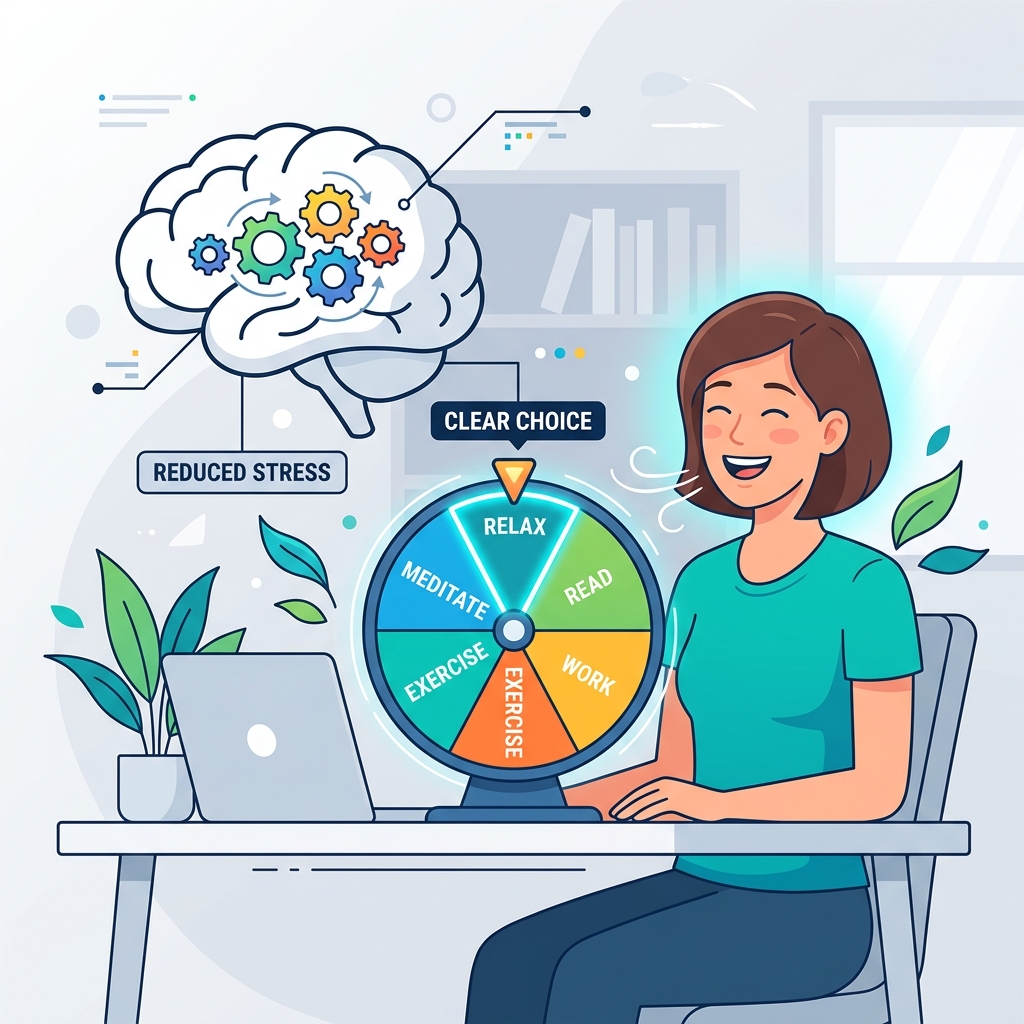
Why Outsourcing Works When you use a random spinner to make a trivial choice, you bypass the cognitive process of weighing pros and cons. You remove the fear of making the "wrong" choice because the decision is out of your hands. This immediate relief of cognitive burden is incredibly satisfying.
Furthermore, outsourcing minor choices helps you bypass the friction of disagreement in groups. Whether you are deciding on a restaurant with your family or assigning minor tasks to coworkers, letting a neutral wheel make the choice prevents arguments and speeds up the process.
Practical Ways to Use a Choices Spinner to Reclaim Your Mental Energy
You can integrate a choices spinner into various parts of your daily routine to simplify your life and conserve willpower:
1. Eliminating the "What's for Dinner?" Debate Deciding what to eat at the end of a long workday is a major source of stress for couples and families. Instead of debating for thirty minutes, create a custom food wheel. * **How to set it up:** Create a wheel on [YaySpinner](/) and populate it with your favorite local restaurants or standard weeknight meals. When dinner time arrives, spin once, and commit to eating whatever the wheel selects.
2. Streamlining Daily Tasks and Chores Tackling a long to-do list of household chores can be overwhelming. We often waste time deciding where to start. * **How to set it up:** Add chores like "Clean kitchen," "Do laundry," "Vacuum living room," and "Take out trash" to the wheel. Let the spinner choose your first task, turning chores into a gamified activity and removing procrastination.
3. Team Brainstorming and Topic Selection In creative meetings, teams often get stuck debating which topic to brainstorm first or who should present their ideas. * **How to set it up:** Put team member names or project themes on the spinner. Let the wheel select the order of presentations or the order of discussion topics to maintain a high-energy, collaborative flow.
4. Overcoming Creative Writer's Block Writers, designers, and developers often waste hours deciding on a style, color palette, or narrative angle. * **How to set it up:** Populate your wheel with different design palettes, prompt themes, or character traits. Spin the wheel to force a creative constraint, which often sparks faster, more innovative output than starting with a blank canvas.
The Cognitive Benefits of Outsourcing Trivial Choices
Outsourcing minor decisions to a random spinner is not just a productivity hack; it has immediate, measurable benefits for your mental well-being:
1. Preserves willpower for high-value tasks By automating minor choices, you keep your prefrontal cortex fresh for creative thinking, complex problem-solving, and emotional regulation.
2. Eliminates buyer's remorse When you choose an option yourself from a large list, you often wonder if another choice would have been better. When a choices spinner decides for you, you accept the outcome more easily, eliminating regret.
3. Builds momentum through rapid action Procrastination is often caused by the friction of starting. Using a spinner to pick your starting point bypasses this mental hurdle, helping you take action immediately and build momentum.
Conclusion: Focus Your Willpower Where It Matters Most
Your mental energy is your most valuable asset. In a world that constantly demands your attention and forces you to choose, protecting your willpower is essential for maintaining focus, productivity, and happiness.
You don't need to overcomplicate your routine to reduce decision fatigue. By identifying the trivial, low-stakes choices that clutter your day and outsourcing them to a neutral tool, you can free up valuable mental space.
If you are ready to simplify your daily choices, head over to the YaySpinner choices spinner to create your own customized decision wheels. Whether you're planning dinner, organizing chores, or running team meetings, let a random spinner do the heavy lifting—and save your brainpower for the choices that truly define your success.